Are text messages admissible in court in Georgia?
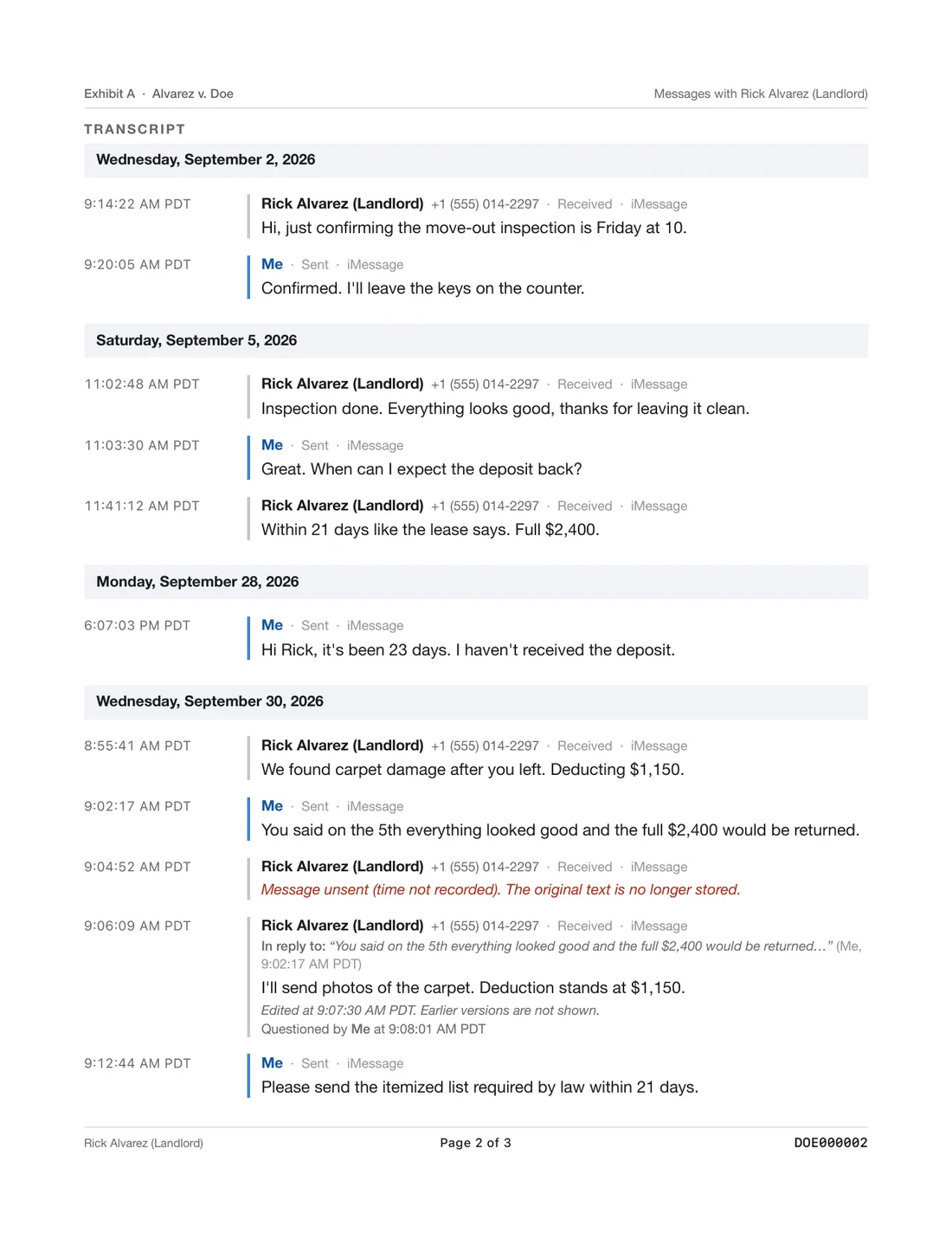
Text messages can be used as evidence in Georgia, but like any exhibit they must be authenticated under Georgia Code section 24-9-901 and must get past the hearsay rules in Title 24, and the judge decides whether they come in. Free screenshots are a start, but a complete copy of the conversation with the date, time and phone number on every message gives you more to show who sent each text and when.
Georgia's Evidence Code is Title 24
Georgia does not have court-made "Rules of Evidence" like many states. Its evidence law is a statute: the Evidence Code in Title 24 of the Official Code of Georgia Annotated (O.C.G.A.). Lawyers and judges cite section numbers such as 24-9-901 for authentication and 24-8-801 for hearsay. The Supreme Court of Georgia has described the current code as containing a comprehensive authentication statute that is nearly identical to a federal rule (Baker v. State, 2024).
Authentication: O.C.G.A. 24-9-901
Under 24-9-901(a), authentication is met by evidence sufficient to support a finding that the item is what the person offering it claims. The Supreme Court of Georgia has said this can be done through any of a variety of means. One example the statute lists, in 24-9-901(b)(1), is testimony of a witness with knowledge that a matter is what it is claimed to be.
Georgia's top court has applied this to texts directly. In Moss v. State (2025), it relied on 24-9-901(a) when it found the evidence was enough for a jury to find when a text was sent. In practice people authenticate a conversation with their own testimony, the other person's phone number, details only that person would know, and replies that fit the conversation. Our page on how to show texts are real goes through these.
Hearsay: O.C.G.A. 24-8-801 and 24-8-802
Section 24-8-801(c) defines hearsay as a statement, other than one made by the declarant while testifying at the trial or hearing, offered in evidence to prove the truth of the matter asserted. Section 24-8-802 says hearsay is not admissible except as the hearsay article provides.
Two points come up with texts. First, Georgia treats a party's own statement offered against them as an admission. Section 24-8-801(d)(2)(A) says admissions are not excluded by the hearsay rule, and the Supreme Court of Georgia applied it to a defendant's message in Carrillo v. State (2025). Second, a text offered for something other than its truth may not be hearsay at all: in Moss, the court held a text saying "I need you to come home!" was offered to show the sender's fear, not to prove she needed someone home. Ask your lawyer how these rules apply to your messages.
Screenshots or a full export?
- Screenshots: free. Swipe left in the iPhone conversation to show each message's time before you capture it. Screenshots often miss the date on each message and show a contact name instead of the number. See are screenshots admissible.
- Print from a Mac: if Messages in iCloud syncs to your Mac, open the conversation in Messages, scroll up until everything has loaded, then choose File > Print and save as PDF.
- Back up with Finder: connect the iPhone to a Mac, open Finder, select the phone, and under General click Back Up Now. The backup keeps a copy of the messages as they are today.
- TextExhibit: a Mac app that reads the Mac's Messages, the iPhone over a cable, or a Finder backup, and exports one conversation to a PDF with the date, time to the second, sender name and number on every message, page numbers and a cover page that records how the copy was made. Exporting with a watermark is free; $24.99 once removes it.
What to keep in mind
- This is general information, not legal advice. The cases mentioned here are criminal appeals used to show how the Supreme Court of Georgia reads the Evidence Code. The judge in your case decides whether any exhibit is admitted.
- An export shows what is on the phone or in the backup. It does not prove by itself who typed the messages, and it cannot bring back messages deleted before the backup was made.
- Statutes change. Check the current text of Title 24 before relying on a section number, and ask the clerk or a lawyer if you are unsure which version applies.
Questions
Are text messages hearsay in Georgia?
They can be, if offered to prove the truth of what they say. But a party's own statement offered against them is an admission under O.C.G.A. 24-8-801(d)(2)(A), and a text offered for another purpose may not be hearsay at all. The judge decides.
Is Georgia's rule the same as the federal rule?
Very close. In Baker v. State (2024), the Supreme Court of Georgia called the authentication statute, 24-9-901, nearly identical to a federal rule.
Do I need the original phone?
Keep it. If the other side says a message was faked or edited, the judge may want to see the phone. Do not delete the conversation or reset the phone until your lawyer says it is fine.
Does TextExhibit make my texts admissible?
No tool can do that. It makes a complete, readable copy with dates, times and numbers and records how it was made, which helps you explain the messages. Admission is up to the judge.
Sources
- Moss v. State, S25A1239 (texts, O.C.G.A. 24-9-901(a), hearsay), Supreme Court of Georgia (checked November 15, 2026)
- Carrillo v. State, S25A0275 (O.C.G.A. 24-8-801(d)(2)(A), message as admission), Supreme Court of Georgia (checked November 15, 2026)
- Baker v. State, S24A0478 (24-9-901 nearly identical to federal rule), Supreme Court of Georgia (checked November 15, 2026)
- Chapman v. State, S25A0710 (O.C.G.A. 24-9-901(b)(1)), Supreme Court of Georgia (checked November 15, 2026)
- Dees v. State, S25A0600 (O.C.G.A. 24-8-801(c) hearsay definition), Supreme Court of Georgia (checked November 15, 2026)
- Campbell v. State, S24A0578 (O.C.G.A. 24-8-802), Supreme Court of Georgia (checked November 15, 2026)
Export the whole conversation
TextExhibit turns a conversation into one PDF with exact times, names and numbers, photos in place and page numbers, on your Mac. Free to preview; $24.99 once to export.