Are text messages admissible in court in Minnesota?
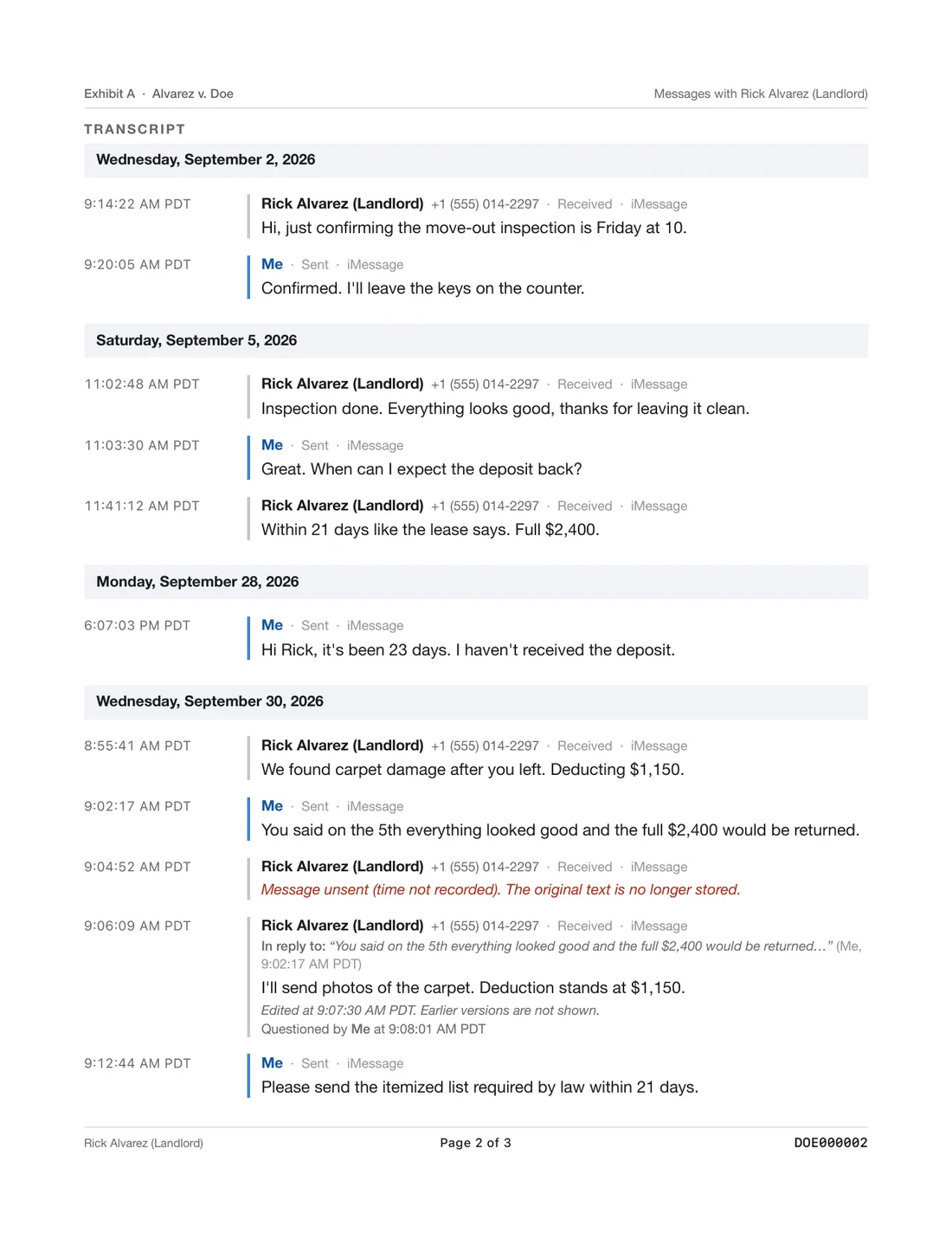
Text messages can be used as evidence in Minnesota courts, but whoever offers them must first authenticate them, under Minnesota Rule of Evidence 901, by showing they are what they claim to be, which usually means testimony from someone who sent or received them. Screenshots or a print from the Messages app on a Mac cost nothing and can work for a few messages; for a long thread, export the whole conversation to one PDF with the date, time and phone number on every message, and ask your lawyer or the clerk what format the court wants.
The Minnesota rule on authentication
Minnesota Rule of Evidence 901, "Requirement of Authentication or Identification," sets the test: the requirement is met by evidence sufficient to support a finding that the item is what its proponent claims. Rule 901(b) gives examples, including testimony of a witness with knowledge and distinctive characteristics such as contents and surrounding circumstances.
In plain English: you have to give the judge a reasonable basis to believe a text is real and came from the person you say. The usual way is your own testimony about the number, your history of texting that person, and what the messages say. Rule 902 lists the narrow kinds of evidence that authenticate themselves, and ordinary text messages are not among them.
Minnesota's rules are published by the Revisor of Statutes, together with committee comments that explain how they are meant to work.
Hearsay: when the content is the problem
Authentication answers whether a message is real. Hearsay is a separate question: whether a statement made outside court can be used to prove that what it says is true.
Minnesota Rule of Evidence 801(d)(2) treats a party's own statement offered against that party as not hearsay. So the other side's texts offered against them usually avoid the hearsay rule; texts from people who are not parties may need an exception.
Screenshots or a full export?
- Screenshots show what the screen showed. They often leave out the exact time of each message and the sender's phone number, and a set of cropped images invites the question of what is missing.
- A full export of the conversation, or of every message in a date range, shows context and makes it harder to argue that messages were picked out. See are screenshots admissible.
- Whatever format you use, keep the phone and the original conversation. If authenticity is disputed, the judge may want to see the messages on the device.
- Do not edit, crop out or highlight anything on the copies you give the court or the other side. Mark up only your own copy.
Preparing the texts
- Free first: for a handful of messages, take screenshots, swiping left in the conversation so the iPhone shows the time of each message. If Messages in iCloud syncs to a Mac, you can also open the conversation in Messages on the Mac, scroll back to load everything you need, and choose File, Print, then save as PDF.
- For a longer thread, open TextExhibit on a Mac, choose where the messages are (the Messages app on the Mac, the iPhone over a cable, or an existing Finder backup) and pick the conversation.
- Choose the whole conversation or a date range. Check the preview: every message shows the date, the time to the second with the time zone, and the sender's name and phone number.
- Add a case title or exhibit label if you have one, then export. You get one PDF with numbered pages, the attachments in a folder, and a manifest listing each file with its SHA-256 hash.
What to keep in mind
- This is general information about Minnesota, not legal advice. Whether particular texts are admitted is up to the judge, applying Minnesota law to your facts.
- An export or printout does not authenticate itself. A witness who knows the messages usually still has to explain where they came from. See how to authenticate text messages.
- Messages deleted before a backup was made are usually not recoverable by any export tool.
Questions
Are screenshots of texts admissible in Minnesota?
They can be, if someone authenticates them and they survive any hearsay or relevance objection. A complete export with dates, times and numbers is easier to authenticate and harder to attack as incomplete. Ask your lawyer which the court prefers.
Where do I upload text message exhibits in Minnesota?
Many Minnesota district courts now take exhibits through the Minnesota Digital Exhibit System (MNDES) rather than on paper. The court's Evidence and Exhibits help page explains how it works, and the notice for your hearing usually says what to do.
Do I need to bring my phone to court?
It is wise to. If the other side disputes the printout, the judge may want to compare it with the messages on the phone. Keep it charged and do not delete the conversation.
Does TextExhibit make my texts admissible?
No tool can do that; admissibility is the judge's decision. TextExhibit produces a complete, consistent PDF with dates, times, numbers and file hashes, which makes it easier for you or your lawyer to lay the foundation.
Sources
- Minnesota Rules of Evidence, Rule 901 (Revisor of Statutes) (checked November 15, 2026)
- Minnesota Rules of Evidence, Rule 801 (Revisor of Statutes) (checked November 15, 2026)
- Evidence and Exhibits (Minnesota Judicial Branch) (checked November 15, 2026)
Export the whole conversation
TextExhibit turns a conversation into one PDF with exact times, names and numbers, photos in place and page numbers, on your Mac. Free to preview; $24.99 once to export.