Can text messages be used in a California divorce or custody case?
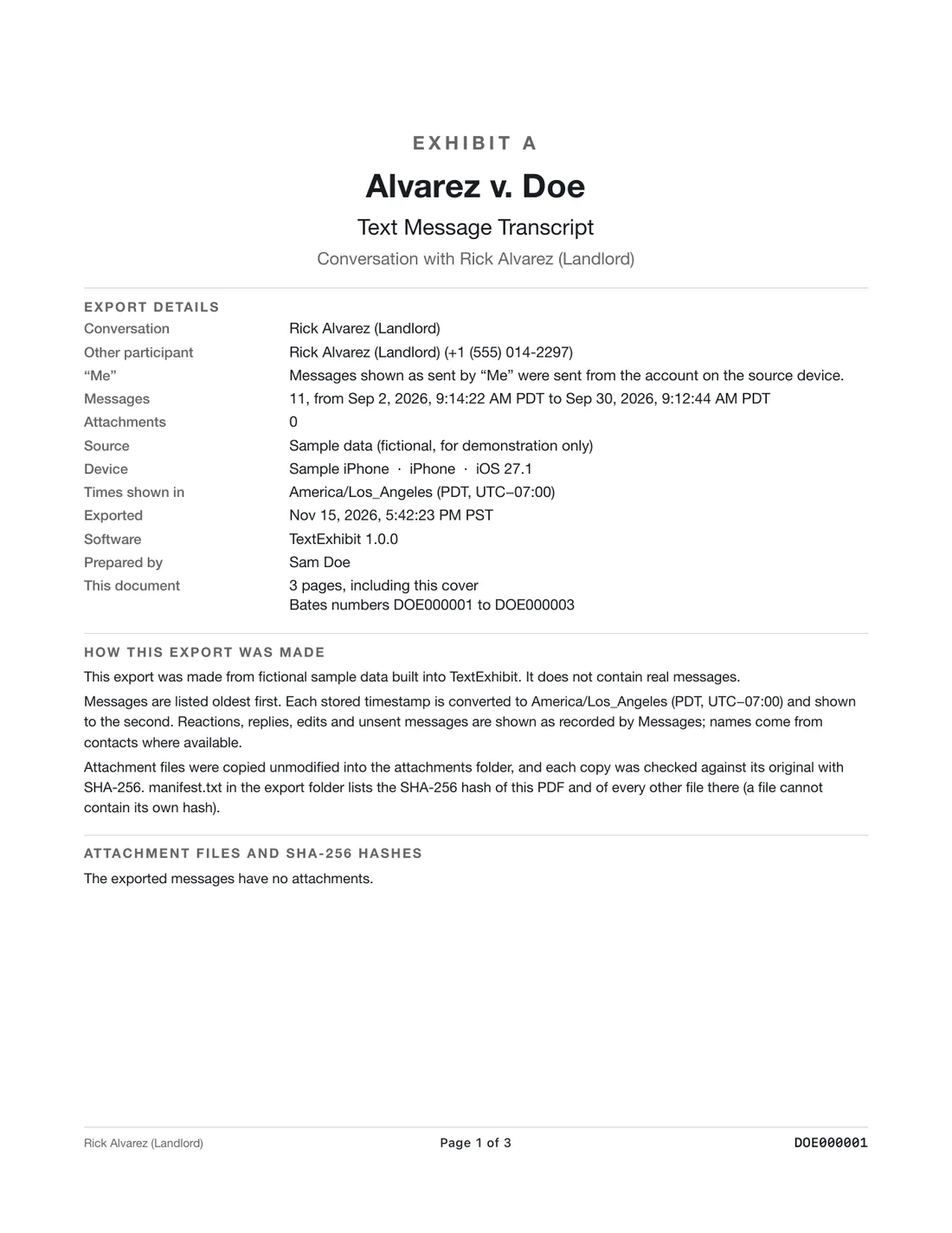
Yes, text messages can be offered as exhibits in a California divorce or custody case, and the California Courts self-help guide explains that any exhibit must be shown to be authentic and relevant before the judge will consider it. Print the relevant conversation with dates, times and numbers, show it to the other side before you ask the judge to admit it, and bring three copies: one for you, one for the court and one for the other party.
Which court hears it
California has 58 superior courts, one in each county, and the divorce petition (FL-100, Petition, Marriage/Domestic Partnership) is captioned for the Superior Court of California in your county. A divorce takes at least 6 months to finish, and many decisions come earlier, at hearings on a Request for Order (FL-300), for example temporary custody, visitation or support. Custody and visitation requests may also go to mediation first.
Every superior court offers some help to people without a lawyer. The self-help guide says you can get free help from your court's self-help center with forms, the process and questions.
How exhibits work in a California family case
The self-help guide's page on presenting your case at a divorce trial describes a set process for showing the judge documents, which it calls exhibits:
- Show the exhibit to your spouse or their lawyer before you ask the judge to admit it.
- Testify about it: what it is and how you got it. For texts, say whose number sent them and that the printout shows the conversation as it appears on your phone.
- Explain how it relates to an issue the judge must decide.
- Ask the judge to admit it. The other side can object. If the judge agrees with the objection, the judge will not consider that evidence.
Copies and the trial brief
- Bring 3 copies of every document you plan to use: one for you, one to hand to the court, and one for the other party or their lawyer.
- At least 5 days before trial, you must prepare a trial brief and serve it on your spouse. It includes a list of the witnesses you plan to call and a short description of what each will say.
- Organize everything so you can find it when you are nervous. The guide suggests a trial notebook, the way many attorneys work.
- Hearsay: the guide warns that repeating what someone else said to prove it is true is usually not allowed. Texts from your spouse are often treated differently from texts from third parties under Evidence Code section 1220. See text messages as evidence in California.
E-filing depends on your court
You can file divorce papers in person (the original and 2 copies) or by mail. The self-help guide says some courts allow e-filing, each court has its own rules and approved e-filing providers, and not all courts offer it. Check your superior court's website. Filing papers is separate from presenting exhibits at a hearing or trial.
Getting the texts onto paper
- Screenshots: free, but they often leave out the date and the phone number. Swipe left in the iPhone conversation to show times before you capture.
- Mac Messages: if your iPhone syncs Messages in iCloud to a Mac, open the conversation, scroll up to load it, then File > Print to make a PDF.
- Finder backup: back up the iPhone in Finder (General > Back Up Now) so you keep a copy even if the phone is lost or reset during the case.
- TextExhibit: exports one conversation, or a date range, to a PDF with the date, time, sender name and number on every message, page numbers, optional Bates numbers, a case title and an exhibit label. Free with a watermark, $24.99 once without.
What to keep in mind
- This is general information, not legal advice. Local rules and your judge's orders control format and deadlines. Ask a lawyer or your court's self-help center.
- Video and audio recordings, and remote hearings, can have extra steps. Ask your court's self-help center before the hearing.
- Read the whole thread, including your own replies, before you use it. The judge will see both sides.
Questions
Do I have to show my spouse the texts before the judge sees them?
Yes. The self-help guide says you show an exhibit to your spouse or their lawyer before asking the judge to admit it, and you bring a copy for them.
How many copies of the texts do I need?
The guide says three: one for you, one for the court and one for the other party or their attorney.
Can I e-file in my California divorce?
It depends on the county. Some superior courts accept e-filing through approved providers and some do not. Check your court's website.
Should I print the whole conversation?
Usually the parts that matter with enough context that nothing looks cut out. Evidence Code section 1402 makes you account for anything that appears altered.
Sources
- Present your case at a divorce trial, California Courts Self-Help Guide (checked November 15, 2026)
- Prepare for a divorce trial, California Courts Self-Help Guide (checked November 15, 2026)
- Request for order, California Courts Self-Help Guide (checked November 15, 2026)
- File divorce papers, California Courts Self-Help Guide (checked November 15, 2026)
- Divorce in California, California Courts Self-Help Guide (checked November 15, 2026)
- Start a divorce case, California Courts Self-Help Guide (checked November 15, 2026)
- Services at court, California Courts Self-Help Guide (checked November 15, 2026)
- Superior Courts, California Courts (checked November 15, 2026)
- Petition, Marriage/Domestic Partnership (FL-100), Judicial Council of California (checked November 15, 2026)
Export the whole conversation
TextExhibit turns a conversation into one PDF with exact times, names and numbers, photos in place and page numbers, on your Mac. Free to preview; $24.99 once to export.