Can text messages be used in a Colorado divorce or custody case?
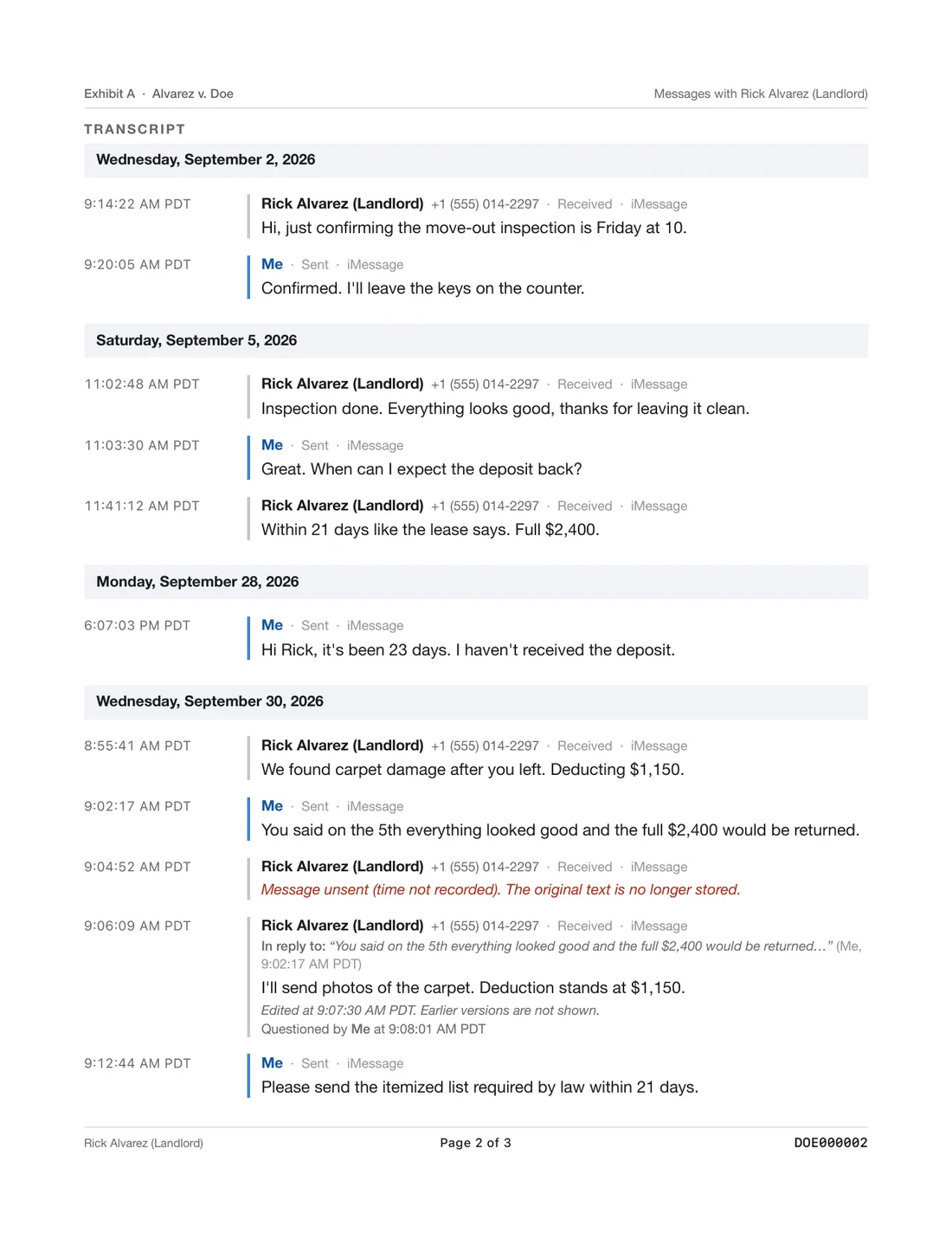
Yes, text messages can be offered as exhibits in a Colorado divorce, legal separation or parenting case, which is heard in the District Court, and the judge decides whether each one is admitted. Print or export the conversation with dates, times and numbers, give each exhibit a number or letter, list it on the court's Exhibit List (JDF 72), and follow the deadlines in your Case Management Order for sharing it with the other side.
Where the case is and who can help
In Colorado, a divorce or legal separation is filed in the county where you or your spouse lives, either online or in person at your local District Court. The Judicial Branch's step-by-step page says you or your spouse must have lived in Colorado for at least 91 days before filing, and that children must have lived in Colorado for at least 182 days (or since birth).
Every judicial district has a Self-Help or Court Resource Center staffed by Self-Represented Litigant Coordinators, called Sherlocks. They can point you to the right forms and explain the process, but they cannot give legal advice. The Judicial Branch also lists Family Court Facilitators, who may run the early conference in a family case.
When texts come up in the case
After the petition is filed, the court holds an Initial Status Conference with a Family Court Facilitator, Magistrate or Judge, and you get a Case Management Order. Read it closely. It sets the deadlines that matter for exhibits. Texts often matter later, at a hearing on temporary orders or at the final hearing, for example to show what was agreed about parenting time or how the other parent communicated.
The court's case process page lists the forms people commonly file before a hearing or trial:
- Pretrial Statement (JDF 1129).
- Witness List (JDF 71).
- Exhibit List (JDF 72). For each exhibit you write the number or letter you gave it and a short title, and there are columns to note whether the other side objects, and why, or whether all parties agree it can be presented.
- Subpoena forms (JDF 79 instructions, JDF 80) if you need someone to bring records or come to court.
Filing through Colorado Courts E-Filing
Colorado Courts E-Filing (CCE) is open to people without a lawyer only in domestic relations and eviction cases, so divorce and parenting cases qualify. You register for a user ID, then "Opt In" to connect your account to an existing case, which can take up to 2 business days. Each filing costs an $18 e-filing fee on top of any court fee, and you can include several documents in one filing.
The court's tips are worth following for a text exhibit: scan or upload each document separately, because the court cannot split or merge pages, and check that every page is readable, because the court cannot fix unreadable documents. A single PDF per exhibit, with page numbers, avoids both problems. For technical help, E-Filing support is at (720) 625-5800, weekdays 7 a.m. to 6 p.m.
Getting the texts into a usable exhibit
- Screenshots: free, but they often leave out the date on each message and the phone number. Swipe left in the iPhone conversation to show times before you capture.
- Mac Messages: if your iPhone syncs Messages in iCloud to a Mac, open the conversation, scroll up so it loads, then File > Print to save a PDF.
- Finder backup: back up the iPhone in Finder (General > Back Up Now) so you keep a copy even if the phone is lost or reset while the case is open.
- TextExhibit: exports one conversation, or just a date range, to a PDF with the date, time, sender name and number on every message, page numbers, and an exhibit label and case title on the cover page. Free with a watermark, $24.99 once without. See exporting a date range.
What to keep in mind
- This is general information, not legal advice. Your Case Management Order and the judge's orders control deadlines and format. Ask a lawyer, a Sherlock or a Family Court Facilitator.
- If you received a fee waiver, the court's E-Filing page says you currently cannot e-file, so you would file at the clerk's office instead.
- Do not mark up the copies you give the other side or the court. Keep your notes on your own copy.
Questions
Do I have to give my spouse a copy of the texts I plan to use?
Expect to. The Exhibit List (JDF 72) has columns for whether the other side objects or agrees, which assumes they have seen your exhibits. The exact deadline and method are in your Case Management Order or the judge's orders.
Can I upload screenshots to CCE as exhibits?
You can e-file documents into your own domestic relations case once you have opted in. Ask the clerk or a Sherlock whether your judge wants exhibits filed, exchanged, or brought to the hearing.
Should I print the whole conversation?
Usually the parts that matter, with enough context around them that nothing looks cut out. A date-range export is a common middle ground, and page numbers make it easy to point the judge to one message.
Can a Sherlock tell me which texts to use?
No. Sherlocks can help with forms and procedure but cannot give legal advice or advocate for you. For strategy, talk to a lawyer.
Sources
- Divorce or Legal Separation, step-by-step, Colorado Judicial Branch (checked November 15, 2026)
- Family Cases: Case Process (Initial Status Conference, JDF 1129, JDF 71, JDF 72), Colorado Judicial Branch (checked November 15, 2026)
- Exhibit List (JDF 72), Colorado Judicial Branch (checked November 15, 2026)
- E-Filing for Non-Attorneys, Colorado Judicial Branch (checked November 15, 2026)
- Self-Help Resources (Sherlocks), Colorado Judicial Branch (checked November 15, 2026)
Export the whole conversation
TextExhibit turns a conversation into one PDF with exact times, names and numbers, photos in place and page numbers, on your Mac. Free to preview; $24.99 once to export.