Can text messages be used in a Connecticut divorce or custody case?
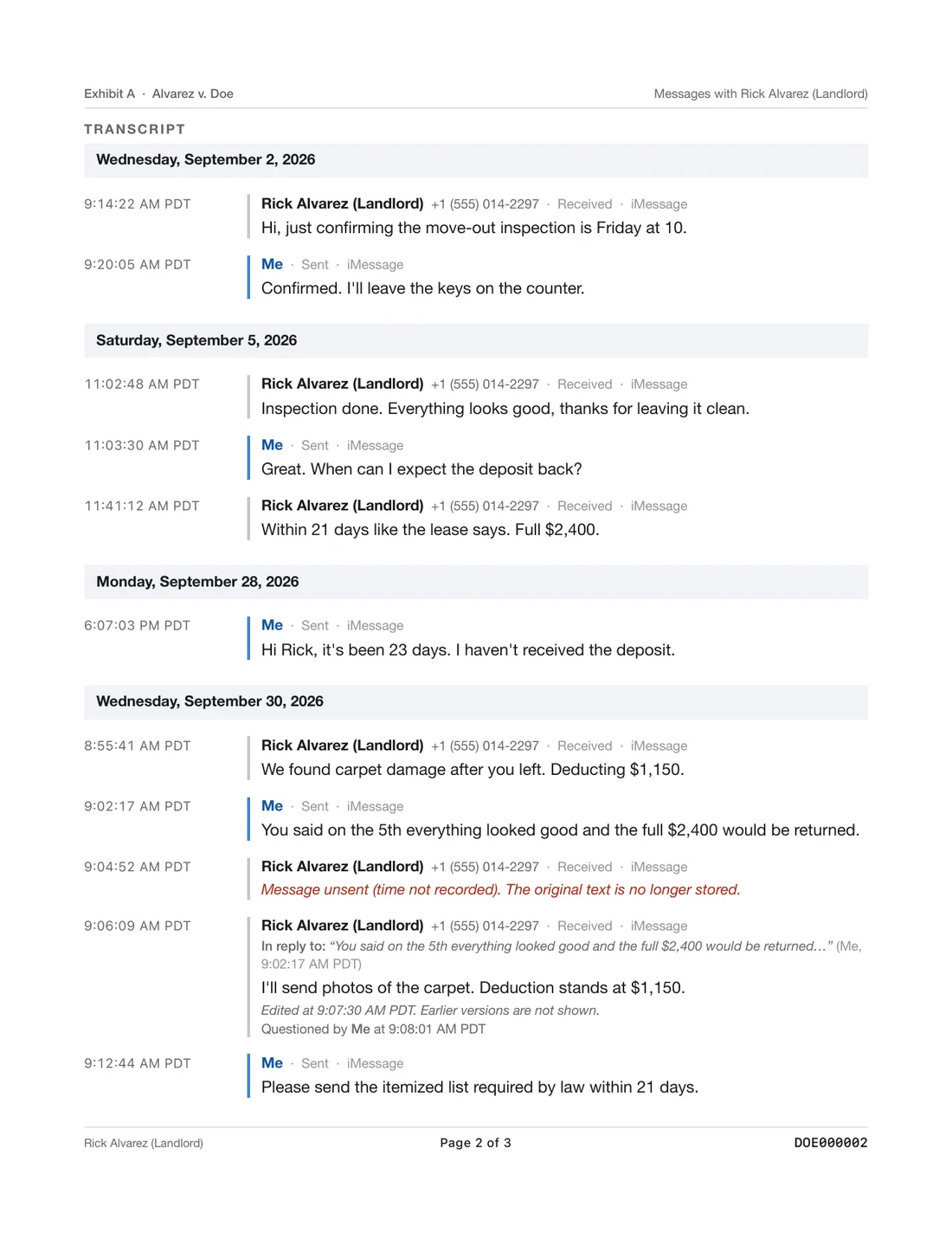
Yes, text messages can be offered as exhibits in a Connecticut divorce, custody or visitation case in the Superior Court, and the Judicial Branch lets parties submit exhibits electronically as PDF files through E-Services, which is optional if you represent yourself. Export or print the conversation with dates, times and numbers into a single PDF per exhibit, and either submit it with "E-File an Exhibit" in E-Services or bring paper copies, as your judge directs.
Where the case is and how it moves
Family cases in Connecticut, including dissolution of marriage, legal separation, custody and visitation, are heard in the Superior Court. Since 2021 they follow a process called Pathways, now set out in Practice Book Section 25-50A, effective January 1, 2025.
After you file, the case gets a Resolution Plan Date. A Family Relations Counselor, a court employee trained in family matters, meets with both sides to see where you agree and disagree, then recommends a track: A for the simplest cases, B for moderate ones, and C for cases with major disputes. A judge then issues a scheduling order. In tracks B and C there are usually Case Dates, short hearings before a judge on temporary orders such as custody or support while the case is pending, and possibly a trial date.
The Resolution Plan Date is not a contested hearing. Texts are more likely to matter at a Case Date, a motion hearing or the trial. Have them ready before then.
Submitting texts as electronic exhibits
Since November 16, 2020, attorneys must submit exhibits electronically, in PDF, in paperless civil and family cases. For self-represented parties it is optional. If you use it, you log in to E-Services, look up your case, and choose "E-File an Exhibit" from the menu. The Judicial Branch says the electronic exhibit in the court's e-filing database becomes the official exhibit and is treated as the original.
That last point matters for texts. Whatever PDF you upload is what the judge will see. A file with every message dated and timed, the sender's number visible and pages numbered is easier to rely on than a set of cropped screenshots.
Some exhibits cannot go in electronically, including video or audio files and anything that cannot be converted to PDF. A screen recording of your phone, for example, would have to be submitted in physical form.
Getting set up in E-Services
- Enroll: go to the E-Services welcome page, click Enroll, choose a user ID and password, and activate the account from the email you receive.
- Request electronic access to your existing family case from the Civil/Family/Housing menu, so you can view and file documents in it.
- Prepare one PDF per exhibit. Name each clearly, for example "Exhibit 4 - texts with respondent, May 2026".
- Ask the clerk or the Court Service Center whether your judge has any extra exhibit instructions.
Getting the texts into a PDF
- Screenshots: free. Swipe left in the iPhone conversation to show times, then combine the images into one PDF on a Mac using Preview.
- Mac Messages: if your iPhone syncs Messages in iCloud to a Mac, open the conversation, scroll up so it loads, then File > Print > Save as PDF.
- Finder backup: back up the iPhone in Finder (General > Back Up Now) so you keep a copy during the case.
- TextExhibit: exports a conversation, or a date range, straight to a PDF with the date, time, sender name and number on every message, page numbers, and an exhibit label and case title on the cover page. Free with a watermark, $24.99 once without. See what format lawyers want.
What to keep in mind
- This is general information, not legal advice. Your scheduling order and the judge's orders control deadlines. Court Service Center staff can help with procedure, not legal advice.
- Court Service Centers are in Superior Courthouses and generally open 8:30 a.m. to 5:00 p.m. on weekdays. For one-on-one help, the Judicial Branch asks you to email [email protected] rather than come in.
- If a restraining or protective order protects you, you can ask in writing at least two days ahead to appear or testify remotely in a family proceeding, using form JD-FM-295.
Questions
Do I have to e-file my exhibits if I don't have a lawyer?
No. The Judicial Branch says electronic submission of exhibits is optional for self-represented parties. It is mandatory for most attorneys.
Can I upload a screen recording of the messages?
Not through electronic exhibits. Video and audio files are on the list of exhibits that must still be submitted in physical form. A PDF of the conversation can go in electronically.
Should I put the whole conversation in?
Usually the relevant stretch, with enough context that nothing looks cut out. See exporting a date range.
Will the Family Relations Counselor look at my texts?
The counselor's job on the Resolution Plan Date is to understand the issues and recommend a plan, not to rule on evidence. Bring a summary of what the texts show, and keep the full copies for hearings.
Sources
- The Pathways Process in Your Divorce, Custody or Visitation Case, Connecticut Judicial Branch (checked November 15, 2026)
- Electronic Submission of Exhibits in Civil and Family Matters, Connecticut Judicial Branch (checked November 15, 2026)
- E-Services for Self-represented Parties, Connecticut Judicial Branch (checked November 15, 2026)
- Divorce, Custody and Visitation, Connecticut Judicial Branch (checked November 15, 2026)
- Court Service Centers, Connecticut Judicial Branch (checked November 15, 2026)
Export the whole conversation
TextExhibit turns a conversation into one PDF with exact times, names and numbers, photos in place and page numbers, on your Mac. Free to preview; $24.99 once to export.