How to organize text messages for a divorce by topic
Keep one complete, unedited export of each conversation, then build topic folders and a simple index that points back to dates in that export, instead of cutting the texts apart. Name files by date range and person, add a one-page spreadsheet listing topic, date, time and what the message shows, and give your lawyer the full exports plus the index.
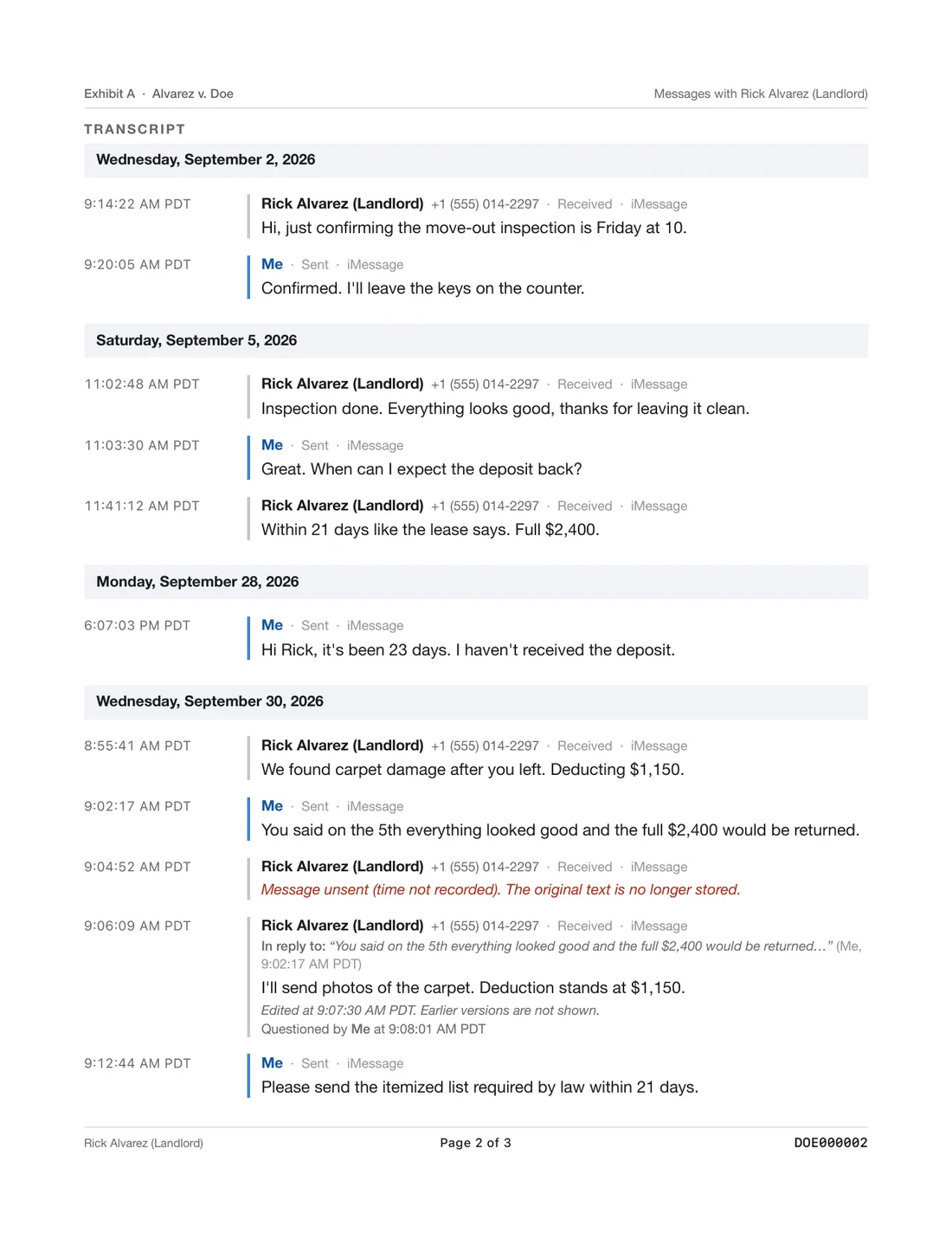
Why you keep the full thread as the master copy
A message pulled out of the middle of a conversation can look misleading, and the other side may ask for what came before and after. A lawyer will want to be able to show the whole thread. So never rearrange or trim the original export. Topic sorting is a layer on top of it.
A folder layout that works
- 01 Full exports: one folder per conversation, such as “Spouse, 2024-01-01 to 2026-10-31” and “Group chat, family”.
- 02 Money: your index entries and any bank or receipt documents that match a text.
- 03 Children and parenting.
- 04 Separation and property.
- 05 Conduct: threats, insults, admissions.
- 06 For lawyer: the index spreadsheet and a short cover note.
The index spreadsheet
Use five columns: topic, date, time, who sent it, and one plain sentence on what it shows. Add a column for the page number of the PDF. Write facts, not conclusions: “Spouse says the account was moved to a new bank” works better than “Spouse admits hiding money”. Your lawyer decides what it means.
Export a CSV of the conversation from TextExhibit. It has one row per message with date and time, so you can filter, copy the relevant rows into the index and keep the same timestamps. See exporting texts to CSV or Excel.
Steps
- Export each conversation in full with TextExhibit: PDF for reading, CSV for sorting.
- Read through the PDF once with a highlighter or the CSV filter, noting dates for each topic.
- Build the index with those dates and page numbers.
- Check three or four entries against the PDF to make sure the date and time match.
- Ask your lawyer whether to turn on Bates numbers before you export for production. See Bates numbering.
Mistakes to avoid
- Renaming or editing the exported PDF.
- Mixing your notes into the exported file.
- Sorting only the damaging messages and leaving out the context.
- Losing the link between the index and the original date.
What to keep in mind
- General information, not legal advice. Your lawyer may prefer a different layout or may handle the sorting themselves.
- Messages that were deleted before the backup do not appear, so the index can only cover what you have.
- Topic labels are your own reading of the messages. Keep them factual.
Questions
Can I put the texts in a binder by topic?
You can for your own review, but keep the full export as the master and ask your lawyer before giving anyone a re-ordered set.
Should I tell my lawyer how I sorted them?
Yes, include the index and a short note on how it was made.
Do I need CSV and PDF both?
PDF is for reading and filing. CSV is useful for filtering and building the index. TextExhibit makes both in one export.
Export the whole conversation
TextExhibit turns a conversation into one PDF with exact times, names and numbers, photos in place and page numbers, on your Mac. Free to preview; $24.99 once to export.