Are text messages admissible in court in DC?
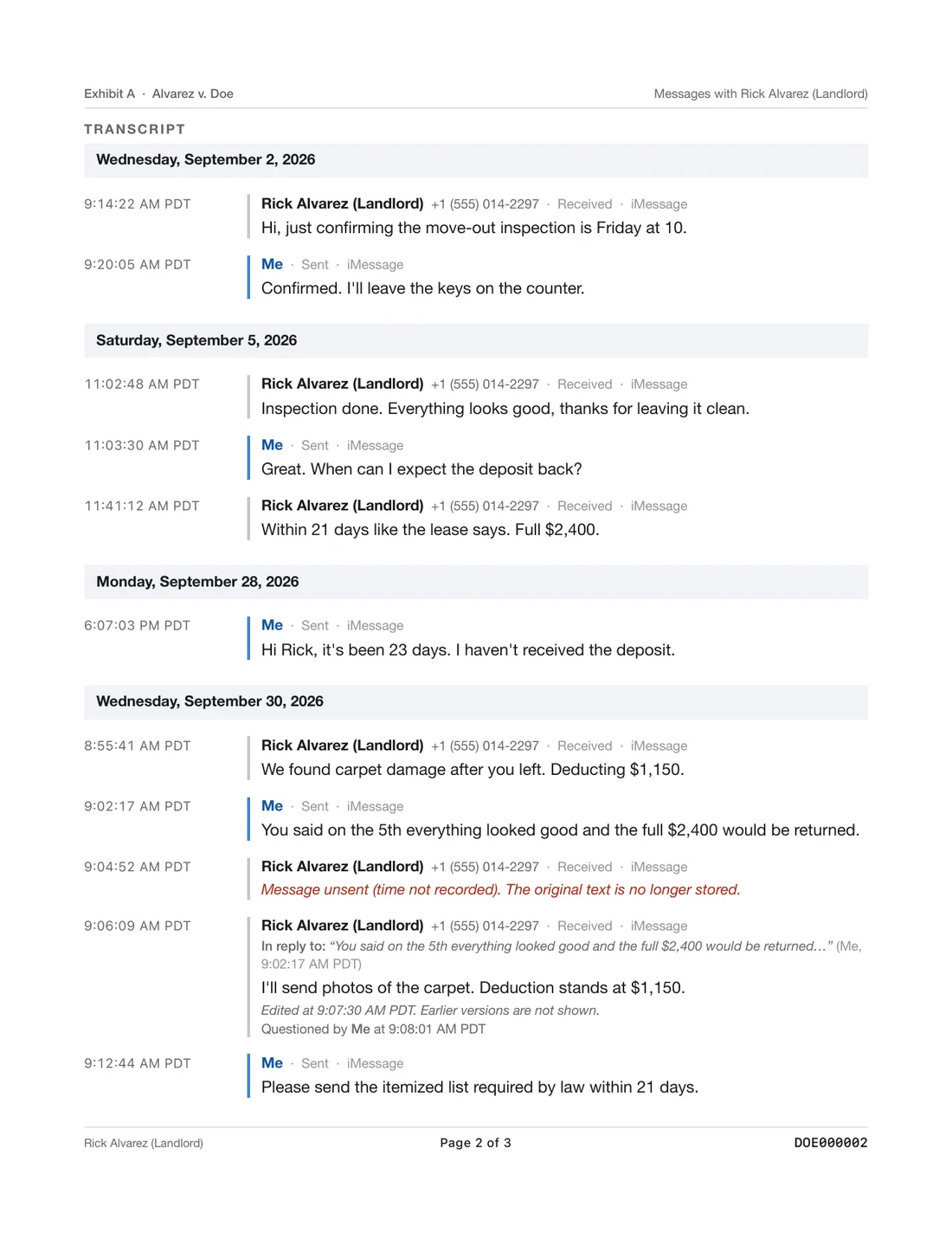
Text messages can be used as evidence in the District of Columbia, and the DC Superior Court's own Pro Se Guide to Evidence in DC Family Court names texts as documentary evidence, but you must lay a foundation showing the messages are what you say they are, and the judge decides whether they come in. Free screenshots are a start, but a complete copy of the conversation with the date, time and phone number on every message makes it easier to answer the foundation questions, such as whose number it is and how you know.
DC has no numbered rules of evidence like most states
Most states have a numbered set of evidence rules, often with a Rule 901 on authentication. DC is different. The Superior Court's rules page lists rules of procedure for each division, such as Civil Rule 43 (Evidence) and Criminal Rule 26 (Evidence), but no separate set of rules of evidence. Some evidence law is in Title 14 of the DC Code, called Proof, which has chapters on evidence generally, competency of witnesses and documentary evidence. Many other questions are answered by court decisions rather than a numbered rule.
So for a DC case, do not look for a "DC Rule 901." Ask a lawyer which statute or decision applies to your messages, and use the court's own self-help material for the practical steps.
Laying a foundation for texts
The court's Pro Se Guide to Evidence in DC Family Court explains that to lay a foundation you must prove the exhibit is what it is and that it is authentic. Its table of questions for texts is short and practical. After the exhibit is marked, the witness is asked: What is this? Who is it from? Whose number is that? How do you know? Who is it to? How do you know?
Those questions are why the phone number matters. A screenshot that shows only a contact name like "Mom" or "J" makes "whose number is that" harder to answer. A copy that shows the number on each message lets you point to it. Our general page on how to authenticate texts covers other ways people connect messages to a sender.
Hearsay and objections
The same guide lists hearsay among the common objections the other side may raise, along with objections like "more prejudicial than probative." The judge rules on each objection. Whether a given message is hearsay, and whether an exception applies, depends on who wrote it and why you are offering it, so ask a lawyer before trial.
The guide also suggests talking to the other side beforehand to stipulate to authentication, meaning you both agree not to object to an exhibit's authenticity. That can save you from calling extra witnesses.
Screenshots or a full export?
- Screenshots: free. Swipe left in the iPhone conversation to show each message's time before you capture. Check that the number, not only a name, is visible. See are screenshots admissible.
- Print from a Mac: if Messages in iCloud syncs to your Mac, open the conversation in Messages, scroll up until it has loaded, then choose File > Print and save as PDF.
- Back up with Finder: connect the iPhone to a Mac, select it in Finder, and under General click Back Up Now, so a copy survives if the phone is lost or reset.
- TextExhibit: a Mac app that exports one conversation to a PDF with the date, time to the second, sender name and phone number on every message, page numbers, and a cover page recording how the copy was made. Free with a watermark; $24.99 once removes it.
What to keep in mind
- This is general information, not legal advice. The judge decides whether any exhibit is admitted. Ask a lawyer, the Family Court Self-Help Center, or the clerk of the division handling your case.
- An export shows what is on the phone or in the backup. It does not prove by itself who typed the messages, and it cannot bring back messages deleted before the backup was made.
- The guide also warns that until an exhibit is admitted, you can only ask the foundation questions about it, not questions about what it means. Enter each exhibit as you introduce it.
Questions
Does DC follow the Federal Rules of Evidence?
Not as a code of its own. The DC Superior Court's rules page has no separate rules of evidence. Some evidence law is in Title 14 of the DC Code, and much of the rest comes from court decisions. A lawyer can tell you what applies.
What will the judge ask about my texts?
The court's evidence guide suggests foundation questions like: What is this? Who is it from? Whose number is that? How do you know? Be ready to answer them in your own words.
How many copies should I bring?
The Family Court evidence guide says at least 3 copies of each exhibit for an in-person hearing: one for you, one for the judge and one for the other side.
Does TextExhibit make my texts admissible?
No tool can do that. It makes a complete, readable copy with dates, times and numbers and records how it was made, which helps you answer foundation questions. Admission is up to the judge.
Sources
- Pro Se Guide to Evidence in DC Family Court, DC Superior Court (checked November 15, 2026)
- Rules of the Superior Court, DC Courts (checked November 15, 2026)
- DC Code Title 14, Proof, Council of the District of Columbia (checked November 15, 2026)
Export the whole conversation
TextExhibit turns a conversation into one PDF with exact times, names and numbers, photos in place and page numbers, on your Mac. Free to preview; $24.99 once to export.