Using text messages in a Massachusetts divorce or custody case
In Massachusetts, divorce and custody cases go to the Probate and Family Court, and text messages are used like any other exhibit: shared with the other side and the court under the court's procedures, with someone who knows the messages ready to confirm they are accurate. Save the full conversations first, free with screenshots or a print from Messages on a Mac, or as one exported PDF with dates, times and phone numbers, then ask your lawyer or the court's self-help staff how your court wants exhibits delivered.
The court and how filing works in Massachusetts
In Massachusetts, divorce, custody, parenting time and support cases are heard by the Probate and Family Court, which has a division in each county. The Trial Court's electronic filing system, eFileMA, is open to self-represented litigants as well as lawyers, and the court says eFiling is available in all Probate and Family Court divisions.
Not every document can be eFiled. The court publishes a list of available eFiling codes, and anything not on that list still has to be filed by mail or in person. eFiled documents also do not reach the docket until court staff review and accept them, so do not assume a document is filed the moment you upload it.
Exhibits are a separate question from pleadings. Text messages you want the judge to consider are usually attached to an affidavit or financial statement, exchanged with the other side, or marked as exhibits at a hearing or trial. Which of those applies depends on the stage of the case and the judge's orders, so ask the register's office or your lawyer before you send anything.
Which texts tend to matter
- Co-parenting messages: pickups, missed visits, schedule changes, school and medical decisions.
- Agreements and promises about money, support, property or the house.
- Threats, insults or pressure, with the exact date and time.
- Messages that show a pattern over time, not just one bad day. Keep the surrounding messages so the context is clear.
- Only use messages you have a lawful right to. Reading or copying your spouse's phone without permission can create its own problems; see using your spouse's texts.
Preparing the texts as exhibits
- Free first: for a handful of messages, take screenshots, swiping left in the conversation so the iPhone shows the time of each message. If Messages in iCloud syncs to a Mac, you can also open the conversation in Messages on the Mac, scroll back to load everything you need, and choose File, Print, then save as PDF.
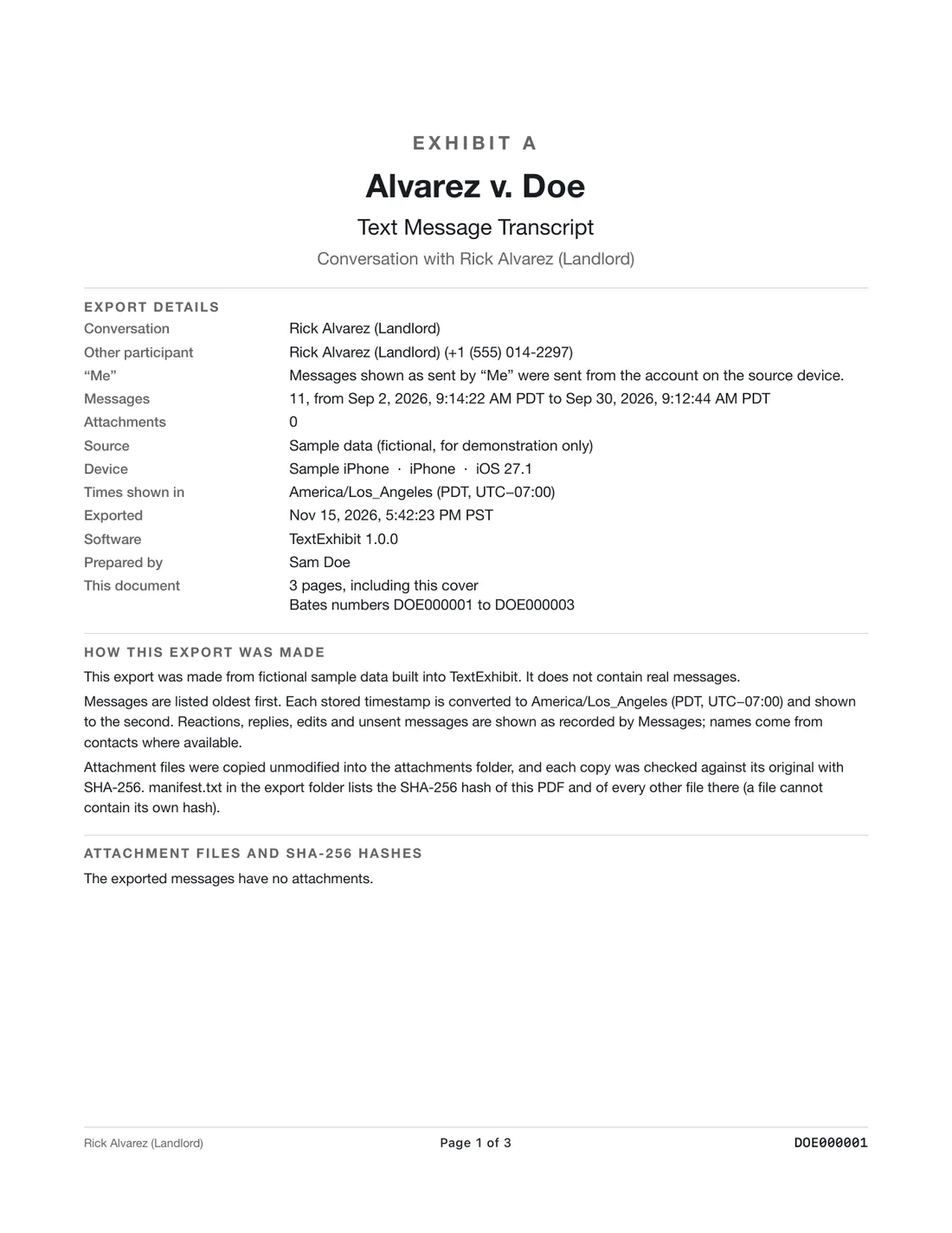
- For a longer thread, open TextExhibit on a Mac, choose where the messages are (the Messages app on the Mac, the iPhone over a cable, or an existing Finder backup) and pick the conversation.
- Choose the whole conversation or a date range. Check the preview: every message shows the date, the time to the second with the time zone, and the sender's name and phone number.
- Add a case title or exhibit label if you have one, then export. You get one PDF with numbered pages, the attachments in a folder, and a manifest listing each file with its SHA-256 hash.
- Give each conversation its own exhibit label and keep the export files unchanged. If your lawyer needs them, see how to give texts to your divorce lawyer.
Where to get help
In Massachusetts, start with the Trial Court's Court Service Centers and the Probate and Family Court register's office. They can explain forms and procedures but cannot tell you which evidence to use. For that, talk with a family lawyer, or legal aid if you qualify.
What to keep in mind
- This is general information about Massachusetts, not legal advice. Procedures differ by county and by judge, and they change.
- Whether texts are admitted, and how much weight they get, is up to the judge. The person offering them usually has to authenticate them. See text messages as evidence in Massachusetts.
- TextExhibit exports one conversation at a time and cannot read WhatsApp, Signal or Facebook Messenger, or recover messages deleted before the backup was made.
Questions
Can text messages be used in a Massachusetts custody case?
Yes, they are common evidence in custody and parenting time disputes, subject to the rules of evidence. The judge decides whether they are admitted and how much they matter.
Can I eFile text messages in the Probate and Family Court?
eFileMA accepts documents in PDF, and an affidavit with printed texts attached is a PDF like any other. Whether your particular filing has an eFiling code, and whether texts belong in a filing at all rather than at a hearing, depends on the case. Check the court's list of eFiling codes and ask the register's office.
Should I print the whole conversation or just the bad messages?
Lawyers usually prefer the full thread or a full date range. Cherry-picked messages invite the argument that the context was left out. Your lawyer can then point to the key pages.
Can I delete texts before the case starts?
Deleting messages that may be relevant to a case can cause serious problems, including sanctions. Keep everything and ask your lawyer before deleting anything.
Sources
- eFiling in the Probate and Family Court (mass.gov) (checked November 15, 2026)
- Available eFiling codes in the Probate and Family Court (checked November 15, 2026)
- Massachusetts Guide to Evidence, Section 901 (checked November 15, 2026)
Export the whole conversation
TextExhibit turns a conversation into one PDF with exact times, names and numbers, photos in place and page numbers, on your Mac. Free to preview; $24.99 once to export.